

HR and Finance rarely agree on the same numbers, and the reasons run deeper than a simple spreadsheet mismatch. It’s a symptom of siloed business processes and disconnected data models that create misalignment at every turn. Underneath that are unclear data definitions, governance strategies without real accountability and cultural priorities that pull the two functions in different directions. When those gaps collide during budgeting, workforce planning or compliance reporting, the pain is immediate and the consequences compound over time.
The urgency to fix this is growing. Enterprises are operating in an environment of economic volatility, cost pressure and heightened scrutiny on workforce investments. HR is focused on talent strategies, engagement and retention. Finance is focused on cost control, forecasting and margin protection. Both are technically correct, but without shared data and governance, neither can act with confidence. It’s no longer enough to reconcile numbers after the fact. As explored by my colleague Rob Kugel in an analyst perspective, finance organizations are increasingly engineering data integrity into the process end to end to eliminate reconciliation work. Enterprises need a model that ensures HR and Finance are working from the same source of truth, with processes and systems that reinforce alignment rather than undermine it. The ISG Buyers Guides for Data Management evaluate software providers and products that help ensure consistent data across an enterprise.
The root causes of the discord are well known. Timing differences create gaps between when HR updates headcount and when Finance closes the books. Definitions vary between what HR calls “active employees” and Finance’s view of “billable resources” even if the intention for both groups is the same. Governance is often informal, leaving no clear owner for resolving discrepancies or enforcing standards. Technology amplifies the problem. HCM providers point to ERP as the culprit. ERP providers point back to HCM. Software providers that offer both often keep their ERP and HCM architectures siloed, with data workflows that fail to connect meaningfully. In many cases, this is a deliberate choice. Rebuilding from the ground up to unify data models and reporting is costly and complex. But the cost of doing nothing is far greater. Misalignment erodes trust, slows decision-making and creates risk that ripples across compliance, planning and employee experience.
Technology alone cannot fix this. Integration matters, but without business accountability, even the best platforms fall short. A cohesive HR tech strategy must include Finance as a stakeholder from the start. As explored in a prior analyst perspective, data readiness has to be treated as the first priority—because no platform can compensate for incomplete, misaligned or fragmented data. That means defining who owns what, how data is maintained and how decisions are made when conflicts arise. It means documenting processes, accountabilities and change management practices so alignment is not a one-time project but a sustained discipline. Systems should reinforce these rules, not work around them. When governance is clear and technology supports it, alignment becomes a habit rather than a heroic effort.
Providers that ignore this reality will lose relevance. Customers are demanding solutions that bridge HR and Finance, not perpetuate silos. If providers continue to treat integration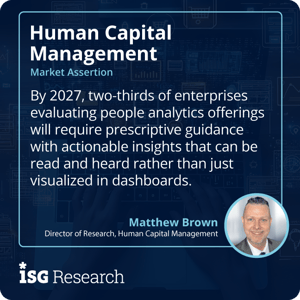 as someone else’s problem, they will chase attrition for the wrong reasons and miss the opportunity to lead. The market is moving toward platforms that can deliver unified reporting and prescriptive insights, not just dashboards that decorate executive presentations. Our research shows this expectation is accelerating. By 2027, two-thirds of enterprises evaluating people analytics offerings will require prescriptive guidance with actionable insights that can be read and heard rather than just visualized in dashboards. Alignment depends on insights that drive decisions, not just charts that look good in meetings.
For buyers, the stakes are even higher. If alignment is ignored, everything breaks. Budgeting chaos becomes workforce planning chaos. Compliance risk multiplies. The pain points you feel today will be exponentially worse tomorrow. Ultimately, the resolution begins with clarity. Evaluate your HR technology strategy alongside your enterprise data management strategy. Identify gaps in definitions, governance and accountability. Document who owns which data elements, how updates flow and how disputes are resolved. Build change management practices that keep HR and Finance aligned as business conditions evolve. Technology should enable this discipline, not replace it.
The market consequences of getting this wrong are visible. Organizations that fail to align spend more time reconciling than planning. They make decisions on stale or conflicting data. They lose credibility with boards and regulators. Conversely, enterprises that build shared data and governance models gain speed, confidence and resilience. They can model workforce costs accurately, forecast with precision and respond to change without scrambling to reconcile numbers. Alignment is not a technical detail. It is a strategic imperative.
The future will demand more than shared dashboards. It will require integrated workflows, predictive analytics and governance frameworks that make alignment automatic. Artificial intelligence (AI) will play a role, but only if it is embedded in processes that enforce consistency and accountability. The organizations that win will treat alignment as a design choice, not a reconciliation exercise. They will embed governance into processes, integrate platforms intelligently and hold stakeholders accountable for maintaining a single source of truth.
When HR and Finance work from the same numbers, trust grows. Decisions accelerate. Risk declines. And the conversation shifts from “Why don’t these numbers match?” to “How do we act on what we know?” That shift is worth the effort—and the cost of doing nothing is far greater.
If you haven’t started, now is the time to evaluate your HR technology strategy alongside your enterprise data governance model. Define ownership, document processes and insist on systems that reinforce alignment rather than create more reconciliation work. Engage both HR and Finance leaders in building a shared framework for data definitions and reporting standards. Treat this as a strategic initiative, not a technical project. The organizations that act now will gain speed, confidence and resilience in a market where precision matters more than ever.
Don’t wait for the next budgeting cycle to expose the cracks. Start the conversation today. Audit your current state, identify gaps and make alignment a design choice—not a rescue mission. The future belongs to enterprises that can trust their numbers. Make sure yours is one of them.
Regards,
Matthew Brown
Fill out the form to continue reading.