

Play audio
Buying HR technology is a significant decision. It requires months of software provider reviews, internal alignment, business case development and implementation planning. When the contract is signed and the system goes live, it often feels like the hard part is over. In reality, the work that determines actual success is just beginning.
Many organizations hold the misconception that implementation marks the finish line. Milestone achieved. Budget spent. Project closed. But anyone who has lived through a go-live knows what often comes next: questions, confusion, resistance to change and a noticeable gap between what was promised and what is actually being used. That gap is where return on investment disappears.
Organizations that fail to realize value from HR technology investments rarely fail because of the choice of software provider. They fail because the organization treated go-live as the end rather than the beginning. That post-go-live reality is why leading organizations treat adoption as a sustained discipline, not a milestone, as explored in a prior research note.
If attention shifts away during this critical window—if leaders assume the technology will “just work”—they miss the most important phase in the lifecycle of the investment.
Think about HR systems the same way you think about people. The people on your team do not thrive with a one-time onboarding and annual review. They need ongoing development, feedback, adjustments and support. Their work processes evolve. Their roles shift. Their challenges change. Why would systems be treated any differently? A new platform is not just a tool; it is an extension of how work gets done. And just like people, systems require investment beyond launch. Waiting for the next software release or contract renewal to revisit configuration is the technology equivalent of waiting until someone quits to ask about their engagement.
The critical post-implementation window requires four things: ownership, enablement, feedback and iteration. Ownership matters because accountability often drops after go-live. The project team disbands, the software provider hands off the keys and day-to-day operations fall into a gray area between human resources information systems, functional teams and IT. That ambiguity slows enhancements, frustrates users and stalls momentum. If no one is clearly responsible for optimization, then optimization does not happen.
Enablement matters because adoption is not a one-time event. Go-live training is necessary, but it is never enough. Users need reinforcement, not just on how to use the system but why it matters. They need to understand how it connects to workflows, performance goals and employee outcomes. Without that connection, users default to old behaviors or ignore the system altogether.
Feedback matters because real usage patterns emerge after go-live, and they rarely match the project team’s assumptions. Leaders need to listen. Are employees finding what they need? Are managers using the data? Are there signals of resistance or missed expectations? That feedback is not noise; it is insight. It should directly inform your next configuration decisions.
Iteration matters because the first version of your HR system is just that—a first version. The organizations that create value over time are the ones that continuously improve—building roadmaps, measuring adoption, revisiting workflows and adjusting based on what is actually working. Without iteration, the system becomes static and eventually irrelevant.
The best results come from leaders who adopt a product mindset. They do not treat systems as fixed deployments but as living parts of the employee experience—subject to regular tuning, stakeholder feedback, and evolving expectations. They embed technology into the rhythm of business operations. New organizational structures? Review reporting lines and approvals. Change in strategic priorities? Reassess dashboards and metrics. Introducing a skills-based hiring model? Talent systems must reflect that logic. Systems should not lag behind change; they should enable it.
This is where the market is heading. By 2027, the focus on employee experience will cause HCM software providers to adapt and redesign their approach to emphasize the employee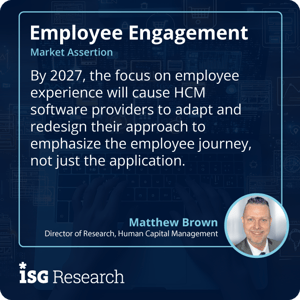 journey, not just the application. In a prior analyst perspective, I explore how that shift is already forcing HR leaders to evaluate whether systems reduce friction across real employee interactions—not just whether features exist.
That shift reflects what leading organizations already understand: Technology is not a static asset. It is a dynamic enabler of culture, performance, and agility.
When post-go-live is treated as a critical phase rather than an afterthought, real results follow. Adoption improves. Data quality strengthens. Trust from the business grows. Over time, organizations reduce the need for reactive fixes, emergency reconfigurations or rushed provider switches. Most importantly, leaders build credibility by sustaining performance rather than simply delivering projects.
So, what helps? Treat your system like a team member. Make time for development, coaching and recalibration. Do not wait for a major problem or a contract renewal to re-engage. Assign clear ownership and maintain it. A system without a steward becomes a system without progress. Make feedback loops a formal process, not a casual suggestion. Encourage input from end users, front-line managers and administrators, and act on it visibly. Create a roadmap that extends well beyond implementation. Your system’s real value starts after the go-live celebration ends.
You have bought the software. That was a big decision. But what you do next—how you support, adapt and grow the system in alignment with your organization—is what will determine whether that investment delivers real, lasting value.
Regards,
Matthew Brown
Fill out the form to continue reading.