

Integration has evolved from a technical requirement into a strategic cornerstone in today’s HR technology landscape. Yet many organizations still treat connectivity between systems as a back-end IT concern rather than the foundation of the employee experience. That mindset is rapidly becoming a liability. The reality is simple: If your systems cannot connect, your strategy cannot connect either.
Integration is not just about convenience—it is about enabling agility, which is the most critical outcome for today’s enterprises. Agility allows organizations to respond quickly to market changes, workforce shifts and evolving business priorities. Employee experience follows closely behind, because a connected ecosystem ensures that people can navigate processes without friction. At the core of both outcomes is data. Integration ensures that data flows seamlessly between critical systems and workflows, but this only works when data origination sources are clearly defined, documented, and maintained. Without that discipline, even the most advanced technology stack will fail to deliver on its promise.
Disconnected systems create fragmented experiences. A candidate applies for a role, but their information fails to carry through to onboarding. A learning platform recommends content that bears no relation to performance goals. A manager attempts to build a succession plan but cannot access reliable skills data from the talent system. These are not isolated frustrations; they are symptoms of an HR technology strategy that lacks cohesion. The future of HR technology is integrated, and organizations that fail to embrace this principle will soon be playing catch-up.
Most organizations did not build a technology stack from a clean slate. Inherited systems from different eras, software providers and philosophies shaped the current state. The result is a patchwork of tools, each functional on its own yet collectively forming a fragmented and often redundant experience. This fragmentation is more than inconvenient; it is costly. It drives low adoption, poor data quality, shadow systems and redundant workflows. Worse, it erodes trust. When employees cannot find accurate information or encounter conflicting data across platforms, they disengage. That disengagement ripples outward, impacting culture, decision-making and ultimately, business performance.
The missteps often begin with provider selection. Too many organizations lack a clear understanding of critical capabilities, processes and data requirements. Decision-making may hinge on the idealized vision shown in demos rather than validation of how the software will perform in the enterprise. Governance failures compound the problem. Data governance, continuous configuration strategies and integrated business workflows are often overlooked, leaving organizations with systems that cannot evolve alongside business needs.
What is missing in many environments is not just better software, but better partnerships. Integration cannot be solved by HR or IT alone. It demands shared accountability among HR, IT and business leaders. HR knows the business of people and how to navigate change management. IT understands the technical architecture and security requirements. The business knows its processes, data and operational nuances. Good collaboration means bringing all of these perspectives to the table with purpose and building a governance model that reflects shared ownership.
Forward-thinking organizations are taking a new approach. These enterprises are not merely implementing systems, but are building ecosystems. Ecosystems require governance, communication and collaboration that transcend traditional silos. A connected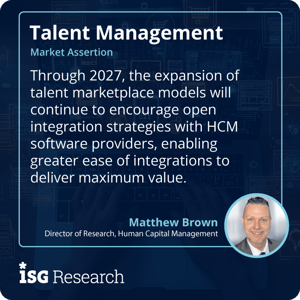 stack enables a connected strategy. It allows learning to reinforce performance, recruiting data to inform workforce planning and AI to match employees to internal opportunities based on real-time skill signals across systems. It makes the employee journey coherent because the underlying infrastructure is coherent. Through 2027, the expansion of talent marketplace models will continue to encourage open integration strategies with human capital management (HCM) software providers, enabling greater ease of integrations to deliver maximum value.
The next wave of transformation will be driven by technologies such as Agentic AI, model context protocol (MCP) and agent-to-agent (A2A) protocol. These capabilities will become the primary point of interaction with the HR ecosystem, replacing the traditional “front doors” of individual systems and modules. As these technologies mature and organizations learn to harness their power at scale, orchestration will become simpler and more intelligent. However, readiness is the prerequisite. Without a well-integrated foundation, advanced AI will only amplify existing fragmentation.
Plugging in also means aligning with enterprise architecture, not working around it. Too often, HR teams invest in platforms that do not integrate cleanly with broader IT or finance systems, assuming these issues will be resolved later. Those workarounds accumulate, costing time, credibility and agility. They slow transformation when speed matters most. Strategic HR technology functions are closing this gap by partnering closely with enterprise architecture teams. These enterprises are mapping data flows across systems, designing for future flexibility and focusing not only on what tools do but on how they communicate. This thinking is what future-proofs the HR technology environment.
If you are advising a CHRO today, the first principle is simple: Go slow to go fast. Take the time to inventory processes and data, and engage a broad range of stakeholders to ensure every perspective is surfaced. Integration is not a technical project—it is an organizational design challenge. When done poorly, the consequences extend far beyond inefficiency. Talent retention suffers when employees cannot easily navigate systems. Compliance risks increase when data is inconsistent or inaccessible. Strategic decision-making falters when leaders cannot trust the insights they receive. Bad data makes everything harder.
Ultimately, integration is not about APIs and endpoints; it is about clarity and coherence. It ensures systems speak the same language, share the same assumptions, and reinforce the same vision of how work gets done and how people grow. If your strategy lives in one place, your systems in another and your people in a third, you are not delivering successful HR—you are digitizing old silos. Organizations that succeed treat integration as a strategic design principle. These enterprises do not simply deploy features, but connect them to workflows, processes and purpose. Systems do not just operate; they orchestrate.
If your current stack feels heavy, disconnected or misaligned with your strategy, the next best move may not be another platform. It may be a commitment to connection—a commitment to integrate not only systems but priorities, stakeholders and user needs. In today’s HR technology ecosystem, connection is not optional. It is the heartbeat of relevance.
Regards,
Matthew Brown
Fill out the form to continue reading.