

Data sovereignty is no longer a niche compliance concern. It is becoming a defining architectural constraint for enterprise cloud strategy. As regulatory scrutiny intensifies and geopolitical risk becomes harder to ignore, Sovereign Cloud has emerged as a practical mechanism for CIOs to retain control over sensitive data, maintain jurisdictional compliance and reduce exposure tied to cross-border data flows.
At its core, the Sovereign Cloud addresses a simple but pressing problem: global cloud scale does not automatically translate into local legal alignment. Enterprises operating across regions are increasingly accountable for where data resides, who controls it and which laws apply. Sovereign Cloud models are designed to resolve that tension by ensuring infrastructure, operations and governance remain anchored within specific national or regional boundaries.
ISG Research defines a Sovereign Cloud as a cloud model exclusively controlled by an enterprise or a trusted provider, with an explicit focus on local compliance. This model enforces adherence to jurisdiction-specific laws governing data residency, privacy and access. The operational benefit is risk containment. By keeping regulated data within defined geographic borders, enterprises materially reduce legal ambiguity and exposure associated with international data transfers.
This shift is not theoretical. ISG Research asserts that by 2028, 60% of sovereign cloud providers will have completed country-level certifications to deploy isolated, governed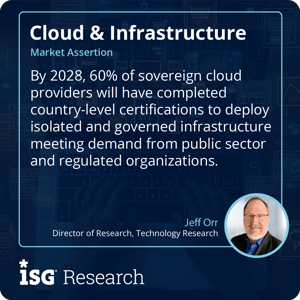 infrastructure to meet demand from public sector and regulated industries. That trajectory reflects sustained pressure from governments, regulators and boards that require demonstrable compliance rather than contractual assurances alone.
Industries with high regulatory density are leading adoption. Telecommunications, financial services, healthcare and the public sector face stringent requirements around data protection, auditability and operational control. In these sectors, Sovereign Cloud platforms enable enterprises to align infrastructure design directly with legal obligations instead of retrofitting compliance controls after deployment. The result is a tighter coupling between cloud operations and governance outcomes.
The Sovereign Cloud did not emerge in a vacuum. Its rise follows a decade of regulatory expansion, publicized data breaches and increasing enforcement activity tied to frameworks such as GDPR and CCPA. As enterprises experienced firsthand the legal and reputational consequences of non-compliance, demand shifted toward cloud models that emphasize control, isolation and transparency over unrestricted scale.
From an IT strategy perspective, Sovereign Cloud platforms have matured rapidly. They now resemble full-stack environments rather than constrained hosting constructs. Security, data protection and compliance are no longer add-ons; they are foundational design principles. This evolution aligns with enterprise investment priorities. In the 2025 ISG Data and AI Market Lens study, 33% of respondents ranked legal and regulatory data compliance among their top five funded initiatives, signaling sustained executive focus on governance-aligned architectures.
For enterprises evaluating Sovereign Cloud options, decision-making must begin with regulatory clarity. CIOs should map the specific legal regimes governing their data, identify regulated data domains and analyze end-to-end data flows. This assessment determines whether Sovereign Cloud adoption is warranted across the entire environment or targeted to specific workloads and datasets.
Provider evaluation is equally critical. Enterprises must assess whether providers offer true infrastructure isolation, enforce data localization and implement verifiable access controls. Certifications matter, but so does operational transparency. Buyers should examine how providers manage encryption, key ownership, audit logging and incident response. Disaster recovery, data integrity and legal accountability should be validated as part of due diligence, not assumed.
Effective Sovereign Cloud software shares several core characteristics. First, it enforces data localization through policy-driven governance frameworks aligned to regional regulations. Second, it integrates robust security controls, including encryption, identity management and role-based access. Third, it provides visibility. Enterprises require management interfaces that expose compliance posture, data usage and operational risk in real time.
Interoperability is another requirement. Sovereign Cloud platforms must integrate with existing enterprise systems and support hybrid and multi-cloud operating models. Sovereignty does not eliminate the need for flexibility. It reframes it. Enterprises increasingly expect controlled interoperability that preserves compliance while enabling innovation across platforms.
Generative artificial intelligence (GenAI) and agentic AI have not yet emerged as native management tools within Sovereign Cloud environments. However, future use cases are clear. AI-driven data classification, automated compliance reporting and localized policy enforcement represent logical next steps. This does not preclude platform-as-a-service (PaaS) and software-as-a-service (SaaS) workloads running on Sovereign Clouds from incorporating AI capabilities, provided security and data governance controls remain intact.
When selecting Sovereign Cloud providers, enterprises should prioritize demonstrable compliance with local regulations, transparent data-handling practices and strong governance models. Total cost of ownership, operational maturity and long-term roadmap alignment should be weighed alongside technical capability. Sovereignty is not a one-time decision; it is an ongoing operational commitment.
The ISG Buyers Guide™ for Sovereign Cloud Platforms evaluates providers across a comprehensive set of criteria, including compliance certifications, infrastructure isolation, scalability, governance, security, AI readiness, multi-cloud compatibility and sustainability practices. The research assesses 16 providers: AWS, Bleu, Clever Cloud, CloudFerro, Delos Cloud, Google Cloud, IONOS, Microsoft, OpenNebula, Oracle, OVHcloud, SAP, Scaleway, Schwarz Digits, T-Systems and Vultr.
For CIOs and IT leaders navigating regulatory complexity, Sovereign Cloud is no longer a defensive posture. It is a strategic control plane for risk, trust and long-term resilience. To understand which platforms align with your regulatory obligations and operational requirements, explore the ISG Buyers Guide™ for Sovereign Cloud Platforms and engage ISG Research for a deeper, market-specific assessment.
Regards,
Jeff Orr
Fill out the form to continue reading.