

This year at ZohoDay 2026, the conversation did not center on product features, competitive positioning or even individual applications. Instead, it focused on a tension many CROs are already experiencing. Revenue leaders are being asked to deliver higher forecast confidence, manage margin pressure and incorporate AI into selling motions while simultaneously reducing operational complexity. The risk is that buyers react by pausing investment or by chasing incremental tools that promise short-term productivity but deepen long-term fragmentation. The takeaway is not that CRM and sales platforms matter less in this environment. The takeaway is that the standard evaluation criteria many organizations still use no longer align with the role revenue technology now plays inside the enterprise.
The most important signal from the event was the shift from productivity software to execution infrastructure. For the past decade, revenue technology has been evaluated on how it helps sellers work faster. That lens no longer reflects how organizations actually use these platforms. The forecast is now a financial input that affects hiring, capital planning and operating guidance. When this shift happens, CRM becomes part of governance rather than convenience. Zoho repeatedly framed software as moving from assisting users to executing outcomes, a broader market shift in which tools evolve from improving productivity to delivering business results. This shift is reflected in our Revenue Lifecycle Management Buyers Guide, in which Zoho was rated Exemplary. CROs should evaluate systems based on how they enforce operating discipline. Pipeline stage definitions, qualification criteria, inspection cadence and auditability of forecast changes matter more than user interface or workflow automation. A system that captures activity but allows inconsistent opportunity management does not improve predictability. The platform’s value is determined by whether leadership can rely on the number, not whether sellers prefer the screens.
A second takeaway was the degree to which fragmentation has quietly become the central cost driver in revenue operations. Many organizations still believe complexity comes from legacy systems, yet the reality is that complexity has increasingly come from modern software procurement patterns. ISG’s Market Lens study of 2026 budgets from 300 enterprises shows an average of nearly 1000 applications in each organization. Often, these applications are superficially connected but operationally disconnected, creating duplicated processes and inconsistent rules. Zoho’s argument is not simply consolidation for cost savings. The argument is that disconnected systems create operational ambiguity. When opportunity data, customer data and contract data live in different control environments, revenue decisions depend on interpretation rather than process. For CROs, this shows up as forecast volatility, inconsistent pipeline reviews and late deal surprises. Rationalization therefore should not be a counting exercise focused on vendor reduction. The correct objective is concentrating revenue decision making into a single governed context. Buyers should ask a different question during evaluations. Instead of asking whether a platform is integrated, they should ask whether it removes the need for interpretation. Integration connects systems. Governance aligns behavior.
The third observation concerned AI. Through 2027, 1 in 5 enterprises will create additional value by utilizing AI and analytics to continuously analyze and recommend improvements to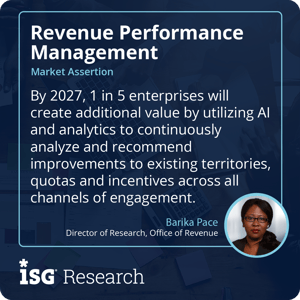 existing territories, quotas and incentives across all channels of engagement. Much of the industry discussion treats AI as a feature layer on top of CRM. The sessions instead highlighted that AI changes accountability more than functionality. Automated qualifications, forecasting assistance and account prioritization influence financial decisions. That shifts risk. Historically, SaaS transferred operational and security risk to the vendor. As decision automation increases, risk moves back to the customer because organizations must trust the outcomes produced by the system. For buyers, this has an immediate implication. The important question is not how impressive the AI output appears in a demonstration. The important question is whether leadership can understand why the system made a recommendation and how errors can be detected. A platform with transparent data lineage, consistent data models and controlled processes is more valuable than one with more visible generative capabilities. AI adoption depends on trust, and trust depends on context and governance rather than model size.
Another notable theme was architecture. Several sessions emphasized that many software providers innovate at the surface while foundational design determines long term cost, control and scalability. This matters to CROs more than it initially appears. Revenue platforms accumulate operational dependence over time. Once forecasting cadence, compensation plans and customer expansion processes rely on the system, replacement becomes disruptive. Buyers therefore should evaluate durability rather than feature velocity. Platforms built on unified data and consistent process models tend to compound value because operational learning stays inside the system. Fragmented systems require organizations to relearn processes every time a workflow changes. The practical implication is that the implementation model should be part of the buying decision. If the vendor cannot describe how customers run pipeline reviews and forecast calls using the platform, the organization will end up designing the operating model alone.
The broader lesson from the event is that the market is not moving away from CRM and sales platforms. It is moving toward treating them as revenue infrastructure. Systems of record and APIs have increasingly become strategic assets because they provide the context required for operational decision making. For CROs, this requires a shift in how purchasing is approached. Evaluations should be anchored in forecast reliability, operational control and governed automation rather than feature comparisons or seller preferences. The technology decision now directly affects financial credibility inside the enterprise. The organizations experiencing frustration with revenue platforms are often not underinvested. They are evaluating the wrong attributes.
ZohoDay 2026 ultimately reinforced a practical point for buyers. The question is no longer which CRM your sellers like using. The question is which platform allows your leadership team to run the business with confidence. The difference between those two questions explains why some organizations feel overwhelmed by their revenue technology while others depend on it. The category has not become less important. Its responsibility inside the enterprise has grown.
Regards,
Barika Pace
Fill out the form to continue reading.