

The most important artificial intelligence (AI) in performance management may not arrive as a flashy chatbot or new dashboard. It may work more quietly than that, sitting inside the performance tool, watching for patterns, connecting signals and nudging managers toward better conversations before performance problems become formal performance events. Not AI as the boss or the judge, and not AI as the invisible hand shaping ratings, pay or promotion decisions behind the scenes.
Performance management has been trying to become continuous for years, yet the experience still feels episodic in many organizations. Employees wait for feedback. Managers prepare too late. Goals are updated after priorities have shifted. Coaching happens when there is finally a problem large enough to force the conversation. The market opportunity sits in that gap between the process companies say they want and the management experience employees receive.
That gap is not only a business process issue. It is also a software issue because most performance tools have been better at capturing performance events than improving what happens between them. They record goals, document feedback, route reviews, support calibration and preserve decisions. Those capabilities matter, but they do not always help a manager see that a goal has gone stale, feedback has become inconsistent or a prior coaching commitment was never followed through.
The more useful and defensible role for AI is embedded support that helps managers notice what they are likely to miss, act before issues harden and coach with better context. As I wrote in an earlier analyst perspective, the real value in HR technology often sits beneath the visible interface in the workflows, data movement, orchestration and intelligence layers. Performance management is a clear example because the most useful AI may be the layer that helps managers act earlier.
Goal alignment and early intervention are where this becomes especially interesting. Managers often struggle because the signals are fragmented. Goals live in one part of the system. Feedback shows up somewhere else. Work changes in the flow of projects, customers, priorities and team dynamics. By the time the performance conversation arrives, everyone is trying to reconstruct a story that should have been visible all along.
AI can help close that gap by flagging goals that have not been revisited as business priorities change. It can surface feedback themes that drift away from stated objectives, remind managers when a promised check-in was never scheduled and summarize prior conversations so a manager can prepare better questions. It can also highlight coaching themes across a team without forcing the manager to rely on memory alone.
None of this requires AI to evaluate the employee. The strongest use cases often stop short of judgment. They reduce surprise, create more chances for correction and give employees a better opportunity to understand expectations while there is still time to act. AI has real potential to make continuous performance less aspirational and more practical, but only if it supports the moments before a decision rather than quietly becoming the decision.
AI will not make a reluctant manager courageous or turn a poor manager into a great one by itself. But it can help more managers enter conversations with a clearer view of what has happened, what has changed and what needs attention. Too much coaching today is vague, delayed or based on the loudest recent event. Better context can move managers from impression to pattern and from generic advice to more specific support.
Software providers need to be pushed harder on this point. A lot of AI performance messaging risks becoming old performance management with summarization, writing assistance and recommendation engines wrapped around it. Useful, yes, but not automatically transformative. If the product mainly helps managers write reviews faster, it may improve administration while leaving the employee experience mostly untouched.
Buyers should be wary of treating AI as another feature column in the evaluation spreadsheet. As I argued in a prior analyst perspective, the better conversation is not whether the technology can do something in a demo. It is what decision, behavior or outcome the technology is designed to improve, what data it uses, who can see the output and how the organization will know whether it is working.
The market impact will be felt by providers, customers and partners in different ways. Providers will need to prove that AI changes the quality and timing of performance conversations, not just the efficiency of review administration. Enterprise customers will need to decide where AI can safely guide managers and where human accountability must remain explicit. Partners will have to help organizations connect product configuration, change management, data governance and manager adoption because the technology will not create better conversations on its own.
Those questions matter more in performance management because the stakes are personal. There is a meaningful difference between AI that helps a manager prepare for a conversation and AI that quietly shapes the outcome of that conversation. One supports judgment. The other risks becoming judgment without accountability. AI can summarize, nudge, detect patterns, suggest questions and help managers follow through. Ratings, compensation, promotions, corrective action and termination require transparent human accountability.
Through 2029, persistent gaps in performance management innovation will fuel a new generation of AI-enabled performance solutions with emphasis on goal-to-work linkage,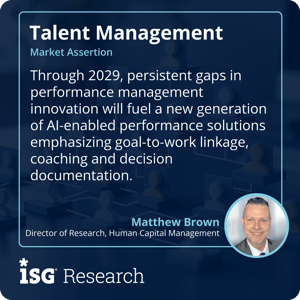 coaching and decision documentation. Performance management is still too disconnected from daily work in too many organizations. Goal alignment, coaching and feedback are usually treated as related concepts, but they often come together only during formal performance events rather than in everyday moments when managers and employees need them most. AI enabled performance software can help connect them, but only if the design intent is broader than automating the old cycle.
The next step for buyers is to ask what management behavior the AI is meant to improve. Does it help managers intervene earlier, make coaching more specific and give employees clearer expectations before a formal review? Does it support transparency, consent and governance in a way employees can understand? Trust will determine whether these tools become useful support or another source of employee anxiety.
The next step for providers is to stop presenting AI as a layer of convenience on top of old performance workflows. Performance software needs to prove it can help managers notice sooner, coach better and connect performance to the work people are doing. The next wave of performance management will not be defined by better documentation of what managers decided. It will be defined by better support for what managers notice, question and coach while there is still time to matter.
Regards,
Matthew Brown
Fill out the form to continue reading.