

Artificial intelligence (AI) screening is forcing recruiting leaders to answer a question many organizations have avoided for years. When technology influences who gets seen, ranked, advanced or ignored, who owns the bias?
The easy answer is to point at the software provider. The equally easy answer is to say the employer owns the hiring decision, full stop. Neither answer is sufficient. Bias in AI-driven hiring is rarely created in one place. It can come from the model, the data, the job criteria, the workflow, the configuration, the recruiter’s use of the recommendation, the hiring manager’s preferences or the organization’s history of decisions. Accountability should follow control, but control is distributed across the hiring system.
For years, AI-enabled screening was discussed as an efficiency play. Recruiting teams could process more applicants, surface stronger matches, reduce manual review and create more consistent evaluation steps. Most enterprise recruiting teams still carry too much administrative work, too many inconsistent manager behaviors and too little time for meaningful candidate engagement. A faster screen can move a strong candidate forward sooner, but it can also reject more people with less human awareness of why it happened.
Recruiting is where a broader enterprise AI question becomes personal. In a prior analyst perspective, Jeff Orr wrote about evaluating AI-powered software by looking at what decisions the system makes, what remains human-led, what data the model uses and who is accountable when the system is wrong. In hiring, those questions cannot stay abstract. The answer may determine whether a qualified person is advanced, ignored or screened out before a human ever engages.
None of this is a reason to reject AI in recruiting. It is a reason to stop treating AI screening as a feature that can be activated, audited once and left alone. Screening is a decision process. Even when AI is framed as matching, ranking, summarization or prioritization, it can still shape human behavior. Recruiters may trust the score. Hiring managers may anchor on the suggested shortlist. Interview teams may give more weight to AI-generated summaries than to original candidate documentation. Candidates may never know which signal affected their progress.
Employers remain accountable for employment decisions, but software providers are not passive participants. Providers own the design choices, model documentation, product claims, configuration controls, audit support, monitoring tools and explainability built into their platforms. If a provider markets AI screening as more consistent, objective or predictive, buyers should expect evidence behind those claims. If the system uses skills inference, ranking logic, assessment signals or candidate recommendations, buyers should expect plain-language documentation of what data is used, what the model does, where human review enters the process and how outcomes can be monitored.
The employer’s responsibility is different. HR and Talent Acquisition own the hiring process, the job criteria, the decision rights and the governance model. A provider can make bias easier to detect, but it cannot define the organization’s hiring philosophy. A provider can support structured workflows, but it cannot force managers to agree on what good looks like. A provider can produce audit logs, but it cannot decide whether the organization is willing to act when the data shows inconsistent outcomes.
In a related analyst perspective, I argued that many ATS problems are really hiring-flow problems. AI screening raises the stakes of that argument. When an organization automates a weak hiring flow, it does not remove the weakness. It gives the weakness speed, scale and a more complicated audit trail.
Bias does not enter the hiring process only at the moment of screening. It can begin with a recycled job description that overstates requirements, an intake process that never clarifies skills, a knockout question that proxies for socioeconomic background, an assessment that has not been validated for the role or an interview process that rewards similarity. AI may not create those issues, but it can normalize them and make them harder to see.
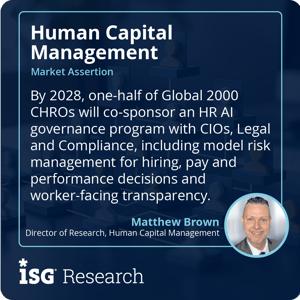 This leads me to assert that by 2028, one-half of Global 2000 CHROs will co-sponsor an HR AI governance program with CIOs, Legal and Compliance, including model risk management for hiring, pay and performance decisions and worker-facing transparency. Recruiting should be one of the first places that governance becomes real. AI screening touches job criteria, candidate data, ranking logic, recruiter behavior, manager judgment and compliance documentation. That is too much decision risk to leave inside a software provider configuration, a procurement checklist or a one-time bias audit.
For providers, the next stage of AI-enabled recruiting differentiation will not come from more confident claims about matching or screening alone. It will come from defensible design. Documentation, explainability, adverse impact monitoring, audit trails, role-based controls and customer-facing governance guidance should become product expectations, not premium extras. Calling something a recommendation does not make it low risk if it changes the order of review, filters a candidate pool or shapes the evidence a recruiter sees first.
For enterprise buyers, the starting point is not the AI feature list. It is the decision map. HR leaders should identify where AI touches candidate outcomes, what decision each capability supports, who can accept or override the recommendation, what evidence is captured and how the organization will monitor results by role, business unit, geography and candidate population. Legal, Compliance, IT and Procurement should be part of that work, but HR cannot outsource the operating model to those functions.
The answer to who owns the bias is not “everyone,” because that can become a polite way of saying no one. Software providers own the safeguards and evidence behind their capabilities. Employers own the hiring decision, process design and use of the technology. HR owns the integrity of the talent process. Regulators set the floor, but they should not be mistaken for the operating model.
Recruiting leaders should act before the next audit, lawsuit or regulation forces the issue. Map every point where AI influences a candidate outcome. Challenge the job criteria feeding the screen. Require providers to explain model behavior and monitoring options in plain language. Define human oversight in operational terms. Review outcomes continuously, not only when a compliance deadline appears. AI can make hiring more consistent, efficient and evidence-based. It can also give old bias new machinery. The difference depends on whether the organization can prove how decisions are made, who owns them and how they are corrected when the process fails.
Regards,
Matthew Brown
Fill out the form to continue reading.