

Black Hat USA 2026 reinforced a practical shift in enterprise cybersecurity: AI is no longer just a threat vector or productivity aid. It is becoming an operating model. The most relevant software provider signals pointed toward agentic security operations, nonhuman identity, runtime control, security data architecture and AI-generated remediation. For CIOs, CISOs, platform leaders and software providers, the issue is not whether AI will change security workflows. It is whether autonomous action should be trusted, constrained, observed and governed.
The agentic SOC strategic narrative was the clearest. Providers are moving from copilots that summarize alerts to agents that investigate, correlate, recommend and, in selected cases, initiate response. That matters because security operations have long been constrained by analyst capacity, alert volume and disconnected tools. Agentic workflows promise faster triage and remediation, but they also create a control problem. Enterprises need to define which actions agents may take independently, which require human approval and which are prohibited in production environments. The question shifts from “Can AI reduce noise?” to “Who governs machine-speed decisions?”
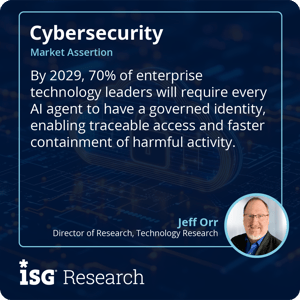 Identity is the next battleground. Human identity programs were not designed for large populations of AI agents, service accounts, automation scripts, APIs and ephemeral workloads. Black Hat signals around nonhuman identity, short-lived credentials, effective permissions and agent access controls show that IAM and PAM are expanding into a broader governance domain. CIOs and CISOs should not treat agent identity as a feature within a platform. It is an architectural requirement. Every autonomous actor needs an owner, purpose, scope, policy boundary, audit trail and revocation path. ISG Research asserts that by 2029, 70% of enterprise technology leaders will require every AI agent to have a governed identity, enabling traceable access and faster containment of harmful activity.
Runtime control is also becoming a distinct security category. Model reviews, red teaming and pre-deployment checks remain necessary, but they are insufficient once agents begin using tools, calling APIs, modifying code, moving data or initiating workflows. The next enterprise control point is the runtime environment where AI decisions become operational actions. This is where the security of AI intersects with cloud platforms, AppDev, DevOps, observability and automation. Enterprises need controls that can inspect prompts, validate tool use, detect policy drift, block unsafe actions and preserve evidence for audit.
A related signal is the growing importance of security data architecture. Agentic security depends on context. Without trusted telemetry from identity, endpoint, network, cloud, SaaS, vulnerability, configuration and business process systems, AI agents will reason from incomplete information. This creates pressure on SIEM, SOAR, observability and data pipeline strategies. The winning architecture may not be another centralized repository. It may be a federated control layer that can access, normalize and act on distributed security signals without copying every dataset into one single platform.
AI-assisted vulnerability discovery and remediation add complexity. AI can identify vulnerabilities, generate patches and accelerate response. It can also produce incomplete fixes, introduce new defects or recommend changes without understanding operational dependencies. Enterprises should evaluate AI-generated fixes as operational change, not just code output. That means testing, approval workflows, rollback plans and accountability must be built into remediation.
For software providers, Black Hat 2026 exposed a positioning contest. Providers of identity, observability, security data platforms and automation are all trying to become the control plane for autonomous security. The competitive question is where enterprise trust will concentrate: security platform, identity layer, cloud runtime, IT workflow system or cross-domain governance fabric.
The advisory takeaway is clear: Enterprise AI security is moving beyond protecting models. It now requires an enterprise control architecture that connects identity, policy enforcement, observability, runtime control and autonomous response. CIOs should use the next six to 12 months to inventory autonomous actors, define control boundaries, update telemetry architecture and decide which platforms are allowed to initiate action. The strategic risk is deploying autonomy faster than the enterprise can govern it.
Regards,
Jeff Orr
Fill out the form to continue reading.