

Play audio
Finance has been a hotbed of technology adaptation, especially in the digital age, because money is just numbers and therefore easily lends itself to new types of digital innovation. For centuries, fortunes were found in removing friction from financial transactions. For example, starting in ancient times, coins were minted to reduce the need for weighing metal in every transaction, along with milled edges to signal fraud if those coins were clipped, reducing their weight. The term seigniorage is the handsome cut the rulers took from every coin minted.
After more than a decade of innovation, payments technology is entering a period of accelerated change. Payment velocity is increasing and is becoming more deeply embedded in business processes as innovators and established institutions adopt real-time financial infrastructure with richer data and reduced latency derived from digital platforms, tokenization, artificial intelligence (AI) and agentic systems. These developments will require enterprises to rethink their treasury operations, fraud management, systems architecture and governance.
While payments were once seen as just a back-office utility or as strategic only for niche business models, all enterprises must focus on how to use them to enhance the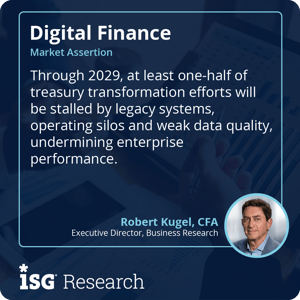 competitiveness and effectiveness of their customer-facing operations as well as significantly reduce avoidable processing costs. However, despite the potential returns, ISG Research asserts that through 2029, at least one-half of treasury transformation efforts will be stalled by legacy systems, operating silos and weak data quality, undermining enterprise performance.
Instant payments are becoming the norm, facilitated by real-time networks such as FedNow in the United States and regulatory mandates for instant Euro payments. So-called bankers’ hours were the norm a century ago because it took a considerable amount of time to foot and reconcile daily transactions. Increasingly, though, the expectation is that money moves continuously, requiring banks and payment providers to adopt low-friction technology platforms to remain relevant. On the buy-side, enterprises must have the ability to manage liquidity, reconcile accounts and detect fraud continuously rather than relying on end-of-day processing.
Account-to-account payments, open-banking interfaces and digital wallets are also challenging card-centric payment models. Payments are increasingly being embedded directly into commerce platforms, business applications and industry-specific workflows. This allows organizations to connect payment initiation with invoicing, identity, financing, reconciliation and customer service. Moreover, in countries with value-added tax (VAT), simultaneous tax payment with each commercial transaction is increasingly the norm to prevent fraud and accelerate receipts.
AI will influence both the operation and initiation of payments. Software and service providers as well as fully mature enterprises are applying AI to fraud detection, transaction monitoring, payment routing, customer service and exception management. This will complement the parallel growth of emerging agentic commerce, where AI agents search, compare and purchase goods or services on behalf of consumers and businesses. Existing card providers have already introduced capabilities designed to identify authorized agents and apply tokenized payment credentials. To take full advantage of the benefits (such as lower transactions cost, decreased rogue spending and reduced duplicate payments), enterprises must establish processes and policies that govern these transactions, create context-defined spending limits, ensure accountability and provide an easily interrogated audit trail.
Payment technology is ushering in major advances in financial operations as well as new risks, rendering real-time fraud prevention and digital identity security increasingly important. Faster payments increase risk by narrowing the window of opportunity to stop or recover an incorrect or fraudulent transaction. Behavioral analytics, biometric authentication, passkeys, network tokenization and verification-of-payee services will become essential components of payment infrastructure. Security controls must operate simultaneously within the transaction flow, replacing those that mainly depend on after-the-fact audits and investigations.
Tokenization and stablecoins will expand the range of payment and settlement options. Tokenization already protects card credentials, but its use is extending to commercial bank transactions, financial assets and programmable contracts. Stablecoins have the potential to improve selected cross-border and always-on settlement use cases, but there are still many regulatory, reserve, interoperability and governance issues.
Well into the 21st century, it’s useful to remember that the foundations of interbank and cross-border payment messaging were laid decades ago when cost and technology constraints forced this data to pass through skinny, highly structured pipes. The adoption of ISO 20022 as the global standard for cross-border payment messages provides for richer, structured data that supports automated reconciliation, compliance screening, cash forecasting and working-capital analytics, among other capabilities. Finance and accounting departments must take advantage of this evolution rather than treating it as a technical conversion.
OK, so for CFOs and Treasury executives, where to start? Right off, does anyone on your team understand digital payments? If the answer is no or only sort-of, there are plenty of tools available that can provide anything from quick or in-depth briefings on the state of technology, technical, legal and regulatory challenges and key questions to ask advisors. There should be a group within the finance and accounting organization with responsibility for this. That’s only the beginning. While technology is essential for business and finance department transformation, it is insufficient by itself. Reimagining financial operations (FinOps) for the digital environment is essential. CFOs and corporate treasurers must modernize processes, data and governance at the same time. Board-level focus on these matters would be helpful to drive change, especially if underpinned by an audit committee perspective.
The second step is to create an enterprise payments and treasury roadmap that is defined by desired business outcomes. These include reducing payment costs, improving working capital, limiting fraud and enhancing customer experience. In larger organizations, this can be tricky because payment activities are typically distributed across functions, systems, banks and countries. So, a smaller demonstration project is usually advisable. In any case, a standing, cross-functional group that connects the various finance, treasury, IT, risk and operating units is needed. Especially at this stage, it’s necessary to assign accountability for results and avoid fragmented ownership of outcomes. Again, board- or executive-level attention and communication are helpful in spotlighting these efforts and setting the stage for a broader rollout.
In parallel, enterprises must assess their ability to support a real-time data and connectivity foundation and highlight gaps that require attention. Connecting banks, treasury management systems and ERP applications through application programming interfaces is necessary to provide continuous cash visibility and support automated reconciliation, forecasting and liquidity movement. ISO 20022 can add richer, more structured transaction data to facilitate analysis and reconciliations. Gaps to address include legacy batch interfaces, inconsistent master data and bank-specific formats because these are common sources of substantial barriers to change.
Along with architecture, enterprises must redesign governed controls for always-on payments, ensuring more than adequate levels of fraud prevention, regulatory compliance or operational resilience. Existing methods are almost certain to be inadequate for immediate and often irrevocable transactions. Systems must support real-time verification of payee, behavioral analytics, tokenized credentials, segregation of duties and continuous monitoring.
Third, as demonstration projects (such as cash forecasting, reconciliation and collections) are rolled out, cross-functional teams should establish measures of business value, govern access to financial data and retain human approval for material decisions. They also should identify issues such as poor data quality, internal skills shortages, and uncertain model outputs. Further, they must routinely assess whether their current direction in road-mapping and deploying AI is feasible and cost effective and adjust these as needed.
I strongly recommend that CFOs and treasurers treat payment modernization as an enterprise transformation rather than a series of technology projects. A wholistic approach that coordinates infrastructure, data, controls and operating processes will be best positioned to convert faster and more intelligent payments into improved financial performance. To support their efforts, enterprises should develop a payment modernization roadmap connecting infrastructure, data, security and operating processes. Near-term priorities should include evaluating real-time readiness, strengthening identity and fraud controls, improving payment-data management and establishing governance for AI-initiated transactions. The objective should not simply be to move money faster, but to make payments more intelligent, secure and integrated with how the enterprise operates.
Regards,
Robert Kugel
Fill out the form to continue reading.