

Analyst Perspectives


Search within Analyst Perspectives blog:

TopBar Analyst Perspectives BottomBar
  • Available Posts: 0

Price and revenue optimization (PRO) software uses analytics to help companies maximize profitability for any targeted level of revenues. PRO utilizes data about buyer behavior to gauge individual customers’ price sensitivity and predict how they will react to prices. It enables users to charge buyers who appear to be less sensitive more than those who appear more price-sensitive. PRO is a...

Read More

Topics: Office of Finance, Revenue Performance, Nomis Solutions, Business Performance, Financial Performance, Financial Services


Because my research practice is centered on important business issues where technology is a key part of a solution, my written perspectives tend to focus on technology. However, it’s almost never the case that a company can just implement some application and fully resolve a business issue. Some progress may be achieved by using more effective tools, but in most cases results will fall short of...

Read More

Topics: Office of Finance, Reconciliation, Business Performance, Financial Performance, Data, Document Management


Managing prices has always been an activity of keen interest to businesses, but it has become even more critical to do it well. Over the past decade many companies have found their ability to raise prices has been constrained by intense competition resulting from Internet commerce, global competition and other factors. One tool for dealing with this pressure is price and revenue optimization...

Read More

Topics: Big Data, Performance Management, Sales, Office of Finance, Operational Performance Management (OPM), Analytics, Business Analytics, Business Performance Management (BPM), Financial Performance Management (FPM), Sales Performance Management (SPM), analytical application, Price Optimization


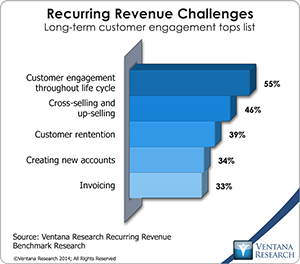
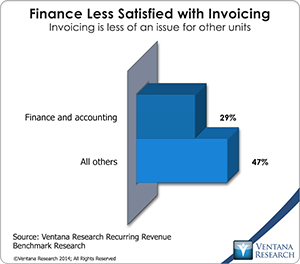
As I noted in a recent analyst perspective note the recurring revenue business model is gaining increasing use worldwide. Our recently completed recurring revenue benchmark research shows that companies are using this business approach because they find that it can convey a strategic advantage in creating additional sales opportunities, making future revenues more predictable, enhancing their...

Read More

Topics: SaaS, Customer Experience, NetSuite, Office of Finance, Recurring Revenue, Zuora, Customer Performance, Operational Performance, Business Performance, Cloud Computing, Customer Service, Financial Performance, billing software, Intacct


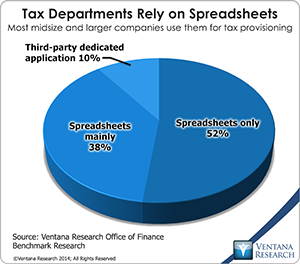
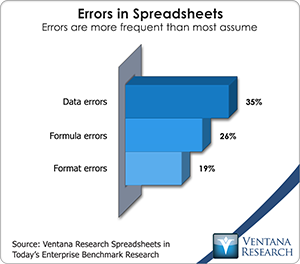
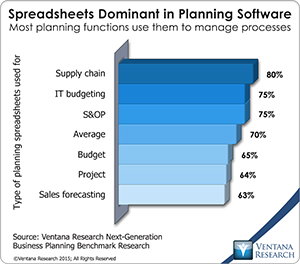
In our benchmark research at least half of participants that use spreadsheets to support a business process routinely say that these tools make it difficult for them to do their job. Yet spreadsheets continue to dominate in a range of business functions and processes. For example, our recent next-generation business planning research finds that this is the most common software used for performing...

Read More

Topics: Planning, Sales Performance, ERP, Forecast, GRC, Office of Finance, Reporting, closing, dashboard, enterprise spreadsheet, Excel, Customer Performance, Operational Performance, Analytics, Business Analytics, Business Collaboration, Business Intelligence, Business Performance, Financial Performance, Information Management, Data, Risk, application, benchmark, Financial Performance Management


Ventana Research recently released the results of our Next-Generation Business Planning benchmark research. Business planning encompasses all of the forward-looking activities in which companies routinely engage. The research examined 11 of the most common types of enterprise planning: capital, demand, marketing, project, sales and operations, strategic, supply chain and workforce planning, as...

Read More

Topics: Big Data, Planning, Predictive Analytics, Sales, Sales Performance, Social Media, Supply Chain Performance, Human Capital Management, Marketing, Office of Finance, Reporting, Budgeting, Controller, Customer Performance, Operational Performance, Business Analytics, Business Performance, Cloud Computing, Financial Performance, In-memory, Workforce Performance, CFO, Supply Chain, capital spending, demand management, Financial Performance Management, financial reporting, FPM, Integrated Business Planning, S&OP


Recurring revenue is a term applied to business models that involve three types of selling and billing structures: a one-time transaction plus a periodic service charge; subscription-based services involving periodic charges; or a contractual relationship that charges periodically for goods and services. Telecommunications was the first major industry to use it, but recently the model has gained...

Read More

Topics: SaaS, Customer Experience, NetSuite, Office of Finance, Recurring Revenue, Zuora, Customer Performance, Business Performance, Cloud Computing, Customer Service, Financial Performance, billing software, Intacct


One of the issues in handling the tax function in business, especially where it involves direct (income) taxes, is the technical expertise required. At the more senior levels, practitioners must be knowledgeable about accounting and tax law. In multinational corporations, understanding differences between accounting and legal structures in various localities and their effects on tax liabilities...

Read More

Topics: Big Data, ERP, Governance, GRC, Office of Finance, audit, finance transformation, LongView, Tax, Analytics, Business Analytics, Business Performance, Financial Performance, Information Management, Oracle, CFO, Risk & Compliance (GRC), Vertex, FPM, Innovation Awards, Thomson-Reuters multinational


Business planning includes all of the forward-looking activities in which companies routinely engage. Companies do a great deal of planning. They plan sales and determine what and how they will produce products or deliver services. They plan the head count they’ll need and how to organize distribution and their supply chain. They also produce a budget, which is a financial plan. The purpose of...

Read More

Topics: Big Data, Planning, Predictive Analytics, Sales Performance, Supply Chain Performance, Human Capital, Marketing, Office of Finance, Reporting, Sales Forecasting, Budgeting, Operational Performance, Analytics, Business Analytics, Business Collaboration, Business Performance, Customer & Contact Center, Financial Performance, Business Planning, Supply Chain, Demand Planning, Integrated Business Planning, Project Planning, S&OP


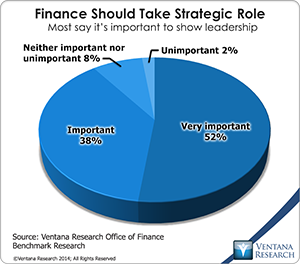
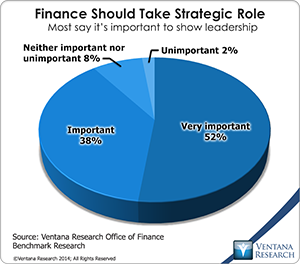
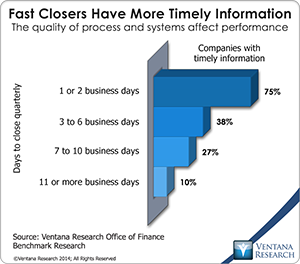
Last year Ventana Research released our Office of Finance benchmark research. One of the objectives of the project was to assess organizations’ progress in achieving “finance transformation.” This term denotes shifting the focus of CFOs and finance departments from transaction processing toward more strategic, higher-value functions. In the research nine out of 10 participants said that it’s...

Read More

Topics: Big Data, Planning, Predictive Analytics, Governance, GRC, Office of Finance, Budgeting, close, end-to-end, Tax, Tax-Datawarehouse, Analytics, Business Performance, CIO, Financial Performance, In-memory, CFO, CPQ, Risk, CEO, Financial Performance Management, FPM


Our recently published Office of Finance benchmark research assesses a broad set of functions and capabilities of finance organizations. We asked research participants to identify the most important issues for a finance department to address in a dozen functional areas: accounting, budgeting, cost accounting, customer profitability management, external financial reporting, financial analysis,...

Read More

Topics: Mobile, Planning, Predictive Analytics, ERP, FP&A, Office of Finance, Reporting, Self-service, Budgeting, close, closing, computing, Controller, dashboard, Tax, Analytics, Business Intelligence, Business Performance, Cloud Computing, Collaboration, Financial Performance, CFO, Data, finance, Financial Performance Management, FPM, Microsoft Excel, Spreadsheets


Our recent Office of Finance benchmark research demonstrates the importance of using automation to execute finance department functions. Information technology systems do at least two things very well that make better use of people’s time, and both of them can substantially improve organizational performance. First, they eliminate the need for people to do repetitive tasks, which frees them to...

Read More

Topics: Big Data, Mobile, Planning, ERP, FP&A, Office of Finance, Reporting, Self-service, Budgeting, close, closing, computing, Controller, dashboard, Tax, Analytics, Business Analytics, Business Collaboration, Business Intelligence, Business Performance, Cloud Computing, Collaboration, Financial Performance, CFO, Data, finance, Financial Performance Management, FPM, Microsoft Excel, Spreadsheets


To help companies improve the efficiency and effectiveness of their payroll management processes, we have assembled our 2015 Value Index for Payroll Management. It evaluates vendors of payroll management software to provide a guide for selecting the right application to suit specific needs. The executive summary is available for download, and this analysis provides a snapshot of the findings....

Read More

Topics: Human Capital Management, Office of Finance, Uncategorized, HR, HRMS, Talent Management


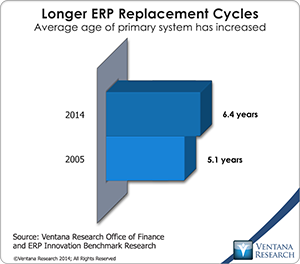
A company’s enterprise resource planning (ERP) system is one of the pillars of its record-keeping and process management architecture and is central to many of its critical functions. It is the heart of its accounting and financial record-keeping processes. In manufacturing and distribution, ERP manages inventory and some elements of logistics. Companies also may use it to handle core human...

Read More

Topics: Sales Performance, Supply Chain Performance, ERP, Office of Finance, Operational Performance, Analytics, Business Performance, CIO, Customer & Contact Center, Financial Performance, Workforce Performance, CFO, Data, HR


SYSPRO is a 35-year-old ERP vendor that focuses on products for midsize companies, particularly those in manufacturing and distribution. In manufacturing, SYSPRO supports make, configure and assemble, engineer to order, make to stock and job shop environments. The company attempts to differentiate itself through vertical specialization and its years of ongoing development, which can reduce the...

Read More

Topics: Performance Management, Supply Chain Performance, ERP, Human Capital Management, Office of Finance, Reporting, cloud ERP, container, Operational Performance, Analytics, Business Analytics, Business Performance, Cloud Computing, Collaboration, Dashboards, Financial Performance, Supply Chain, SCM, S&OP, Digital Technology


Financial management software provider Intacct recently held its seventh annual user conference. In addition to a long list of enhancements in current and upcoming product releases, the company used the occasion to announce Intacct Collaborate, a capability built into its software that enables finance and accounting organizations to work together to answer questions or resolve issues while...

Read More

Topics: Performance Management, Sales Performance, Salesforce.com, ERP, Human Capital Management, NetSuite, Office of Finance, Reporting, cloud ERP, Analytics, Business Analytics, Business Collaboration, Business Performance, Chatter, Cloud Computing, Collaboration, Dashboards, Financial Performance, FinancialForce, Intacct


Finance transformation” refers to a longstanding objective: shifting the focus of CFOs and finance departments from transaction processing to more strategic, higher-value functions. Our upcoming Office of Finance benchmark research confirms that most of organizations want their finance department to take a more strategic role in management of the company: nine in 10 participants said that it’s...

Read More

Topics: Big Data, Mobile, Performance Management, Predictive Analytics, Social Media, ERP, FP&A, Office of Finance, Reporting, Management, close, closing, computing, Controller, Tax, Analytics, Business Analytics, Business Collaboration, Business Performance, Cloud Computing, Collaboration, Financial Performance, CFO, finance, Tagetik, FPM


When applying information technology to drive better business performance, companies and the systems integrators that assist them often underestimate the importance of organizing data management around processes. For example, companies that do not execute their quote-to-cash cycle as an end-to-end process often experience a related set of issues in their sales, marketing, operations, accounting...

Read More

Topics: Big Data, Mobile, Sales Performance, Supply Chain Performance, ERP, Office of Finance, Operations, Management, close, closing, computing, end-to-end, Operational Performance, Analytics, Business Performance, Cloud Computing, Data Management, Information Applications, Information Management, CRM, Data, finance, FPM


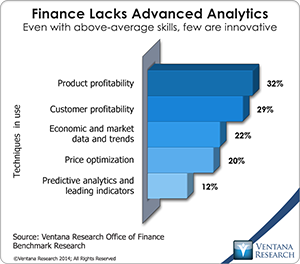
Finance and accounting departments are staffed with numbers-oriented, naturally analytical people. Strong analytic skills are essential if a finance department is to deliver deep insights into performance and visibility into emerging opportunities and challenges. The conclusions of analyses enable fast, fully informed business decisions by executives and managers. Conversely, flawed analyses...

Read More

Topics: Big Data, Mobile, Planning, Predictive Analytics, ERP, FP&A, Office of Finance, Reporting, Self-service, Budgeting, close, closing, computing, Controller, dashboard, Tax, Analytics, Business Analytics, Business Intelligence, Business Performance, Cloud Computing, Collaboration, Financial Performance, CFO, Data, finance, Tagetik, Financial Performance Management, FPM, Microsoft Excel, Spreadsheets


Posts by Topic

see all

Posts by Month

see all