

Analyst Perspectives


Search within Analyst Perspectives blog:

TopBar Analyst Perspectives BottomBar
  • Available Posts: 0

To comply with the Patient Protection and Affordable Care Act (PPACA or Affordable Care Act), which survived a Supreme Court test and a presidential election, all employers with more than 50 full-time employees must be ready by January 2014 to deal with the lion’s share of the law’s employer mandate requirements. Our recent benchmark research on governance, risk and compliance indicates that many...

Read More

Topics: HCM, Office of Finance, Obamacare, Operational Performance, Business Analytics, Business Performance, Financial Performance, Information Applications, Information Management, compliance, Spreadsheets, HR Management


A recent news release by Robert Half, a staffing company that specializes in accounting and finance personnel, covered what it sees as the most important attributes required for auditors in the 21st century. “7 Attributes of Highly Effective Internal Auditors” covers the people dimension of the profession and focuses on the non-technical requirements of the role, including relationship-building,...

Read More

Topics: Fraud, Governance, GRC, Office of Finance, audit, Analytics, Business Analytics, Business Performance, Financial Performance, Governance, Risk & Compliance (GRC), compliance, Infor, Risk, HANA, Oversight Systems


SAP recently announced its new Fraud Management analytic applications. Currently in “controlled” (limited) release, it’s a promising start for the product and a good example of the type of business process revolution that’s possible when companies can execute complex analytics on big data sets using in-memory and other advanced processing techniques. Over the next several years a wide swath of...

Read More

Topics: SAP, Fraud, Governance, GRC, Office of Finance, audit, Analytics, Business Analytics, Business Performance, Financial Performance, Governance, Risk & Compliance (GRC), compliance, Risk, HANA


ParAccel is a well-funded big data startup, with $64 million invested in the firm so far. Only a few companies can top this level of startup funding, and most of them are service-based rather than product-based companies. Amazon has a 20 percent stake in the company and is making a big bet on the company’s technology to run its Redshift data warehouse in the cloud initiative. Microstrategy also...

Read More

Topics: Big Data, MicroStrategy, Office of Finance, Paraccel, Analytics, Cloud Computing, Uncategorized


This is annual report season, the time of year that a majority of European and North American corporations issue glossy paper documents aimed at investors, customers, suppliers, existing and prospective employees as well as the public at large. (Some countries have different conventions; in Japan, for instance, most companies are on a March fiscal year.) In reviewing some of the annual reports...

Read More

Topics: Office of Finance, extended close, US-GAAP, XBRL, Analytics, Business Performance, Financial Performance, Governance, Risk & Compliance (GRC), CFO, compliance, financial reporting, SEC, Digital Technology


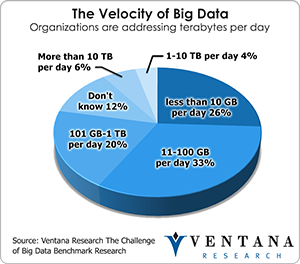
One of the most important IT trends over the past decade has been the proliferation of ever wider and deeper sets of information sources that businesses use to collect, track and analyze data. While structured numerical data remains the most common category, organizations are also learning to exploit semistructured data (text, for example) as well as more complex data types such as voice and...

Read More

Topics: Planning, Predictive Analytics, Customer, Human Capital Management, Office of Finance, Budgeting, close, closing, Finance Analytics, PRO, Operational Performance, Analytics, Business Analytics, Business Collaboration, Business Performance, Cloud Computing, Financial Performance, CFO, Risk, costing, FPM, Profitability


I’m wondering whether the rapid rise in earnings restatements by “accelerated filers” (companies that file their financial statements with the U.S. Securities and Exchange Commission that have a public float greater than $75 million) over the past three years is a significant trend or an interesting blip. According to a research firm, Audit Analytics, that number has grown from 153 restatements...

Read More

Topics: Customer Experience, Governance, GRC, Office of Finance, Reporting, audit, close, Consolidation, Controller, Tax, XBRL, Business Performance, Financial Performance, Governance, Risk & Compliance (GRC), CFO, compliance, FPM, SEC


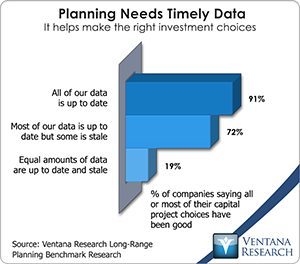
Ventana Research completed an in-depth benchmark research project on long-range planning recently. As I define it, long-range planning is the formal quantification of the strategic plan and how that strategy is expected to play out over a period of time. The benchmark demonstrated that there’s room for improvement in almost every aspect of the long-range planning process. Almost all (95%) of...

Read More

Topics: Big Data, Performance Management, Planning, Office of Finance, Reporting, Uncategorized, CFO, CEO, Financial Performance Management, FPM


Ventana Research recently completed an in-depth benchmark research project on long-range planning. As part of the research we had discussions with CFOs and those involved in financial planning and analysis about their company’s strategic and long-range planning processes, which pointed to the need for clarity in using the terms “strategic planning” and “long-range planning.”

Read More

Topics: Big Data, Performance Management, Planning, Sales Performance, Supply Chain Performance, Office of Finance, Reporting, Operational Performance, Business Performance, Customer & Contact Center, Financial Performance, Workforce Performance, CFO, CEO, Financial Performance Management, FPM


I was discussing the United States Securities and Exchange Commission’s (SEC) eXtensible Business Reporting Language (XBRL) mandate with a former head of investor relations at a Fortune 100 company. His take on it is much the same as that of everyone else involved with corporate reporting: it doesn’t produce much value and costs a bundle to comply. I related to him my thoughts on the lack of...

Read More

Topics: Office of Finance, Reporting, extended close, US-GAAP, XBRL, Analytics, Business Performance, Financial Performance, CFO, compliance, financial reporting, FPM, SEC, Digital Technology


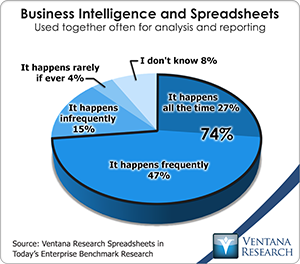
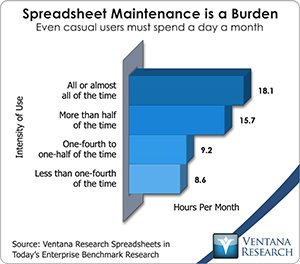
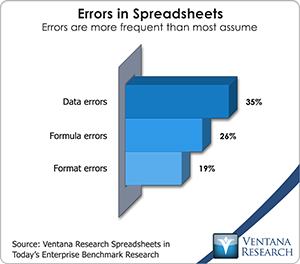
Our recent benchmark research project, Spreadsheet Use in Today’s Enterprise, demonstrated that some companies have made modest progress in addressing spreadsheet issues, but there’s still much left to be done. Desktop spreadsheets can be an important source of productivity but, as I’ve noted, you need to understand their limitations and understand the practical alternatives. Users underestimate...

Read More

Topics: Sales Performance, Supply Chain Performance, Office of Finance, Reporting, enterprise spreadsheet, Operational Performance, Analytics, Business Performance, Customer & Contact Center, Financial Performance, Visualization, Workforce Performance, Risk, benchmark, Financial Performance Management


I’ve been using electronic spreadsheets for more than 30 years. I consider this technology among the 20th century’s top five most important advances in business management. Spreadsheets have revolutionized every aspect of running any organization. A spreadsheet (specifically, VisiCalc) was the original “killer app” that made business people feel the necessity to buy a personal computer.

Read More

Topics: Sales Performance, Supply Chain Performance, Office of Finance, Reporting, enterprise spreadsheet, Operational Performance, Analytics, Business Analytics, Business Intelligence, Business Performance, Customer & Contact Center, Financial Performance, Information Applications, Information Management, Visualization, Workforce Performance, Risk, benchmark, Financial Performance Management
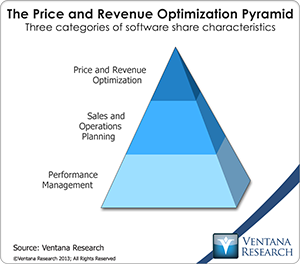

Profit Velocity Solutions’ PV Accelerator is an analytic application designed to enable capital-intensive companies to consistently achieve substantially wider margins and higher return on assets (ROA). Companies in industries such as specialty chemicals, building materials, integrated steel mills and silicon chip fabrication (to name just four) routinely fail to make the right decisions about...

Read More

Topics: Performance Management, Sales, Sales Performance, Supply Chain Performance, Human Capital Management, Office of Finance, PV Accelerator, Operational Performance, Analytics, Business Analytics, Business Performance, Cloud Computing, Financial Performance, Price Optimization, Profit Velocity, Profitability, Software, S&OP


One of the important lessons company executives should have learned over the past 15 years is that it’s dangerous not to do contingency planning, a subject that I’ve written about before. By this I mean real, think-outside-the-box contingency planning (not just extrapolating), which is especially important when doing long-range planning. The past decade or so has been punctuated by periods of...

Read More

Topics: Big Data, Planning, Office of Finance, Reporting, Budgeting, contingency, currency, driver-based, Business Analytics, Business Collaboration, Business Performance, Financial Performance, Financial Performance Management, Integrated Business Planning


To mark the fourth anniversary of the Securities and Exchange Commission’s (SEC) interactive data mandate, Columbia Business School (my alma mater) and its Center for Excellence in Accounting and Security Analysis (CEASA) published a review of the current state of eXtensible Business Reporting Language (XBRL) that notes the manifold issues that plague this promising technology. From its...

Read More

Topics: Office of Finance, extended close, US-GAAP, XBRL, Analytics, Business Performance, Financial Performance, Governance, Risk & Compliance (GRC), CFO, compliance, financial reporting, SEC, Digital Technology


You would think that all organizations would want to maximize the value of every customer relationship, but my research over the last couple of years suggests otherwise. Three particular insights stick in my mind. My research into customer analytics shows that overall customer lifetime value ranked only sixth most important customer-related metric, compared to the highest-ranked, customer service...

Read More

Topics: Sales Performance, Customer Experience, Office of Finance, Voice of the Customer, Operational Performance, Analytics, Cloud Computing, Customer & Contact Center, Customer Service, Call Center, Contact Center, CRM


The electronic spreadsheet is among the top five most important advances in business management to come along in the last hundred years. It revolutionized almost all aspects of running an organization. It was the original “killer app” that made it necessary for people to go out and buy a personal computer. Yet our recent benchmark research project Spreadsheet Use in Today’s Enterprise confirmed...

Read More

Topics: Office of Finance, Reporting, enterprise spreadsheet, Analytics, Business Analytics, Business Performance, Financial Performance, Visualization, Risk, benchmark, Financial Performance Management

Taxes – both indirect (sales or value added taxes, for example) and direct (income taxes) – are one the largest expense items on the corporate income statement. In recent years it has become common for large and even midsize companies to automate their indirect tax management process, but direct tax management has remained a bastion of manual processes built on a heap of desktop spreadsheets. In...

Read More

Topics: ERP, GRC, Office of Finance, audit, finance transformation, Tax, Analytics, Business Analytics, Business Performance, Financial Performance, Governance, Risk & Compliance (GRC), Information Management, CFO, Vertex, FPM


Managing payroll has long been viewed as an administrative task, time-consuming and focused on ensuring that everyone is paid correctly and on time. In fact, in the American Payroll Association’s most recent annual study, the main metrics tracked for payroll performance are payroll cost per employee, payroll processing accuracy rate and dollar value of overpayments – all of which focus only on...

Read More

Topics: HCM, Human Capital Management, Office of Finance, IT Research, Cloud Computing, Information Applications, Workforce Performance, TCM


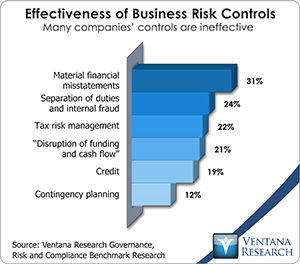
Banking giant JP Morgan raised eyebrows in 2012 when it revealed that it had lost a substantial amount of money because of poorly conceived trades it had made for its own account. The losses raised questions about the adequacy of its internal controls, and broader questions about the need for regulations to reduce systemic risk to the banking system. At the heart of the matter were the...

Read More

Topics: Sales, Sales Performance, GRC, Office of Finance, error, Operational Performance, Business Analytics, Business Collaboration, Business Intelligence, Business Performance, Financial Performance, Information Management, Data, controls


Posts by Topic

see all

Posts by Month

see all